93 rescued from sinking wooden ferry in Surigao

06/10/10 - At least 93 passengers and crew were rescued after an inter-island ferry ran aground off Southern Philippines, coast guard officials said today.

Swift current and strong waves swept the wooden-hulled MB Pilar to the shallow and rocky coast off Bintaogan village in Mindanao’s Surigao City at 9 a.m. on Wednesday, prompting distress calls and a rescue operation by local coast guard personnel and local fishermen, said Philippine Coast Guard Petty Officer 2 Josue Saba.

The sea-craft was carrying 86 passengers and seven crew members from Del Carmen town in Siargao Island and was bound to Surigao City when it encountered huge waves two hours after departure, Saba said.

The victims were brought to shore by pump boats from local fishermen and Coast Guard crafts and are now safe.

Sea accidents are common in the Philippines as sea vessels ranging from outrigger boats to ships are among the frequent mode of transportation around the archipelago.(Philstar)

Mindanao a potential investment hotbed for abalone, says expert

05/31/10 - DAVAO CITY—The abalone industry could flourish in Mindanao due to locations suitable for growing the tropical shelled species, a high-value aquaculture product.

“Mindanao could potentially produce a lot of abalone due to favorable sites, weather, and availability of seaweeds,” said Vincent Encena II, an abalone specialist from the Southeast Asia Fisheries Development Center Aquaculture Department (SEAFDEC-AQD) a research and development institution based in Tigbauan, Iloilo.

Considered a delicacy in Asia, the abalone is a single-shelled, herbivorous marine mollusk found under rocks and coral rubble and is known for its sweet, firm meat.

Encena said Misamis Oriental, Surigao del Sur and the Autonomous Region for Muslim Mindanao (ARMM) particularly Tawi Tawi and Sulu group of islands, where tropical abalone wild stocks may be found, are potential areas for prospective abalone farms.

Encena also mentioned that Siargao Island, Sarangani province and Gen San, with its numerous tuna canning facilities, have the biggest potential areas for abalone growing and processing, respectively. The average abalone production capacity of the identified potential Mindanao areas range from 10 to 50 tons per year, Encena said.

According to Encena, these potential abalone sites have available areas for sea-based farms and access to processors and major abalone markets. These areas are also rich in seaweeds, the staple feed to abalone.

The tropical abalone species found in Southern Japan to northern Australia is the donkey’s ear abalone, Haliotis asinina, locally known as “lapas” in Cebuano or “sobra-sobra” in Ilonggo.

Encena said that canned abalone is one of the preferred product forms in the Chinese market, which is the biggest market for abalone in the world. Each can of abalone may be sold for 750 to 800 pesos per can in the local market and more if sold in the export market, he added.

He said that while a container load of canned tuna is valued at 40,000 US dollars, the same container load of canned abalone would value at around 390,000 US dollars.

However, Encena said that wild stocks of abalone in the Philippines are in decline, due to unregulated harvests and overfishing. He said abalone needs to be farmed or cultured for the future need of the processing industry.

Since most of the tuna canneries in GenSan are not operating fully due to the lack of raw material for canning like tuna, a processing line for abalone may be incorporated in the tuna cannery line with minimum investment, Encena suggested. He added that it was a way for overhead expenses on tuna canneries to be reduced and a high-value canned product, other than tuna, to be produced.

“Mindanao must conduct a more thorough assessment of sites with potential for abalone culture,” he said.

Encena said commercial-scale abalone hatchery and commercial-scale abalone demo-farm must be established for prospective abalone sites in Mindanao to succeed. He added that value-added products from abalone meat should be studied.

The Philippines, in 2006 was the top exporter of frozen abalone to Hong Kong, with around 30 percent, while Australia got around 23 percent of the frozen market. Philippine abalone products are also exported to Taiwan, Japan, Korea and Singapore.

In a presentation made by Encena during the Bimp-Eaga High Value Aquaculture Business Conference held in General Santos City last month, Encena showed the value of world abalone market is pegged at 1 billion US dollars. However, demand for abalone has temporarily decreased due to global economic downturn.

The business conference was aimed at increasing and expanding private enterprises on high-value aquaculture in Bimp-Eaga through the active promotion of joint ventures between and among Eaga members, investment and trading, and export of high-value seafood to target markets.

Encena said that Bimp-Eaga must adopt a unified approach in terms of abalone development in the region through stock assessment of abalone and seaweed, assessment of suitable sites, abalone breeding and culture centers.

He recommended a Bimp-Eaga marketing strategy for various product forms of abalone such as abalone congee and abalone in different sauces and look at non-traditional markets like Europe and the US. (MEDCo)

Mindanao potential top abalone producer

05/30/10 - DAVAO CITY -- Abalone, an edible mollusk lined with mother-of-pearl, could flourish in Mindanao due to its warm seas and could potentially become its high-value aquaculture product.

Vincent Encena II, specialist of Iloilo-based Southeast Asia Fisheries Development Center Aquaculture Department (SEAFDEC-AQD), said Mindanao could cultivate abalone due to favorable sites, weather and availability of seaweeds.

He identified Misamis Oriental, Surigao del Sur and the Autonomous Region in Muslim Mindanao (ARMM), particularly Tawi-tawi and the Sulu group of islands, where tropical abalone wild stocks may be found and are potential areas for prospective abalone farms. Encena also mentioned that Siargao Island, Sarangani province and General Santos City, with their numerous tuna-canning facilities, have the biggest potential areas for abalone growing and processing.

Abalone, a shallow ear-shaped shell and pierced with respiratory holes, is considered a delicacy in Asia. It thrives under the rocks and coral rubble and is known for its sweet firm meat.

Encena said canned abalone is one of the preferred product forms in the Chinese market, which is the biggest market for abalone in the world. Abalone may be sold for P750 to P800 per can in the local market and more if sold in the export market, he added. He said while a container load of canned tuna is valued at $40,000, the same container load of canned abalone would have a value of around $390,000. (Manila Bulletin)

Arroyo inaugurates new road providing link to Siargao airport

05/23/10 - DEL CARMEN, Surigao del Norte - A new road project that links to a newly-constructed airport has been inaugurated in Siargao island on Friday, helping boost tourism in what is considered as an international surfing and fishing hub in the country.

The P152 million Dapa-Del Carmen road project was inaugurated by President Gloria Macapagal-Arroyo, who was accompanied by a small entourage of officials, including Surigao del Norte Congressmen Francisco Matugas and Guillermo Romarate Jr.

The inauguration took place after the President, onboard a Philippine Air Force helicopter, visited the P92-M Sayak International Airport Development Project in the area.

During the visit, the chief executive held a discussion with local officials about the Sayak International Airport building whose construction is still ongoing.

Arroyo and her entourage were also welcomed at the Sayak airport by mayors of the island’s nine towns, some Caraga regional directors and spouses of Congressmen Matugas and Romarate who both won the recently concluded May 11 polls as Governor and Board Member respectively.

Caraga is a special administrative region composed of Agusan del Norte, Agusan del Sur, Dinagat Islands, Surigao del Norte, and Surigao del Sur.

After the Sayak airport visit, President Arroyo and entourage proceeded to Del Carmen town proper to inaugurate the almost eight kilometer road construction and concreting of Dapa-Del Carmen road at Barangay Cancohoy as part of the airport road connection.

The President also did an inaugural drive-thru near the Cancohoy-Sayak Airport road with some cabinet and DPWH officials headed by Secretary Victor Domingo, DPWH Regional Director Evelyn T. Barroso, among others.

Barroso claimed that some of the Siargao Island Infra projects started late 2008 and are targeted to be completed before President Arroyo steps down in June.

After lunch, President Arroyo and entourage is expected to fly to Zamboanga for official visit and inauguration of vital projects there. - (GMANews)

PGMA set to inspect, inaugurate P152-M Sayak Airport development project

Dapa, Siargao Island (14 May) -- President Gloria Macapagal-Arroyo is set to inaugurate and inspect today the P152-million Sayak Airport Development Project (SADP) at Dapa town, Siargao Island.

Surigao del Norte solon Rep. Francisco T. Matugas said the Chief Executive will inspect some of the facilities at the P92-million Sayak Airport and inaugurate the 7.397-kilometer Dapa-Del Carmen road that also connects the new airport, with a total project cost of P152 million.

He also said Mrs. Arroyo, accompanied by nine municipal mayors and their respective local officials, will have an inaugural drive-thru near the Dapa-Cancohoy Road-Section part of the Sayak Airport.

Department of Public Works and Highways (DPWH) Regional Director Dr. Evelyn T. Barroso said the Sayak Airport Development Project was funded under the DPWH regular infrastructure fund.

Some of the projects started late 2008 and are targeted to be completed before President Arroyo steps down in June.

Rep. Matugas said in the inspection and inauguration of the SADP projects, the President will also be accompanied by some Cabinet officials led by Public Works and Highways Secretary Victor Domingo.

Mrs. Arroyo will be welcomed here by Dapa Mayor Peter "Boy" Ruaya and Del Carmen Mayor Bully Navarro.

Matugas said this SADP project is a big boost to the tourism industry in the province. "More tourists, both foreign and domestic mean more income and employment to our locality," he said.

This Siargao Island is already known as the "international surfing and "international fishing hub" the past five years, it was gathered. (MUC/PIA-Caraga)

Siargao hosts international gamefishing tournament

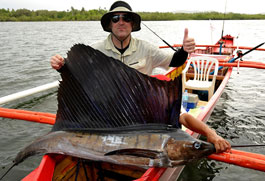
Canadian angler Richard Sharpe proudly shows a sailfish he caught 
off the fishing village of Pilar on Siargao Island during the ‘3rd 
Siargao Gamefishing Tournament 2010’ where anglers from at least 14 
countries participated. (AFP)
Canadian angler Richard Sharpe proudly shows a sailfish he caught off the fishing village of Pilar on Siargao Island during the ‘3rd Siargao Gamefishing Tournament 2010’ where anglers from at least 14 countries participated. (AFP)

BUTUAN CITY – At least 41 anglers across the globe, 18 of them Filipinos, challenge the seas of Siargao Island in Surigao del Norte for the big catch during the “3rd Siargao Gamefishing Tournament 2010” that started Thursday.
Leticia Tan, Caraga Region office of the Department of Tourism (DoT) director, said the participating anglers came from Canada, China, Denmark, Germany, Poland, Japan, New Zealand, Russia, Singapore, Turkey, Taiwan, United Kingdom, United States (US), and the Philippines.
“The anglers will challenge the seas of Siargao for the big catch, their ticket to take home as much as P30,000 to P50,000 cash prize under the five contest categories,” said Tan.
According to Tan, the Siargao International Gamefishing Tournament proved to be a very successful tourism promotional initiative.
She also said that for its 3rd year, the tournament has continued to gain popularity among anglers across the globe making Siargao a favored destination.
During the almost week-long international gamefishing tournament in Pilar town on Siargao Island, the local government units (LGUs) in that so called “Paradise Island” in Northeastern Mindanao, will also present several cultural shows and other prepared programs.
The big international event will close on Saturday where top national, regional, provincial and municipal officials are attending.
DoT Undersecretary for Sports and Wellness Cynthia Carreon was named as guest of honor to grace the affair, Tan added. (ManilaBulletin)

Siargao experiencing power outage for a week now

Siargao Electric Cooperative, Incorporated

04/09/2010 - SIARGAO, Surigao del Norte – Siargao Island is suffering in the dark for a week now. The blackout, however, might continue up until the May elections.

Siargao Electric Cooperative (Siarelco) general manager Sergio Dagooc said the power outage is due to a damaged underwater electric cable.

Dagooc said the cable, located at the vicinity of Barangay Doña Helen in Socorro town, was damaged Thursday last week.

Siarelco has already dispatched divers from Davao City to check the cause.

Dagooc admitted that blackouts may possibly last up to the May 10 elections as they have more than 9 kilometers of cable to check.

Francisco Pobe, regional director of the Commission in Elections (Comelec) in Caraga, meanwhile, said he already informed the central office about the problem.

Pobe has requested power generator sets to address the issue.

The Comelec office in Surigao del Norte, meanwhile, is also working on printing the voters’ list. (abs-cbnnews)

Central Philippines now a world class tourist destination

The Central Philippines Super Region is now a world-class tourist destination, thanks to the various projects which the government has implemented to develop and promote tourism.
The super region comprises Regions IV-B, V, VI, VII, VIII, Camiguin and Siargao Island that derives its allure from its natural wonders, cultural heritage and the hospitality and warmth of their people.
These projects are consistent with the primary variables that drive tourism competitiveness including regulatory/policy framework, business environment and infrastructure, and human, cultural and natural resources that are based on the World Economic Forum’s Travel and Tourism Competitiveness Report.

Regulation and Policy

In terms of regulatory and policy framework, the government has pursued tourism as an economic driver under the updated Medium-Term Philippine Development Plan (MTPDP) capable of attracting 3.27 million tourists, generating US$3.31 billion in visitor receipts and 3.99 million jobs, and contributing US$17 billion or 13.6 percent of Gross Domestic Product this year.

It also has formulated a comprehensive national strategy and sustainable management plan for tourism in the super region.
As with the whole country in general, visa requirements have been reduced and business processes simplified and government services improved in the area.

For example, processing time for business registration at the Department of Trade and Industry (DTI) has been reduced from45-60 days to five days. Also, the Import and Export Application process was cut from four days to 30 minutes and the Environmental Compliance Certificate from 1 year to 20 days.
The Philippine National Police (PNP) has implemented the National TOP COP (Tourist-Oriented Police, Community-Oriented Police) to ensure the safety of foreign and domestic tourists and dignitaries.

Notably, a total of 179 tourist desks/assistance centers, or 60 percent of 297 such centers established nationwide, were established in Central Philippines through a memorandum of agreement among the Department of Tourism, Department of the Interior and Local Government and PNP.
The DOT developed tourism stimulus packages abroad to encourage travelers to visit the Philippines especially islands in Central Philippines. There are also 44 hospitals and health facilities in the country accredited for medical tourism. The country’s retirement industry is another potential growth area in tourism.

Business Environment and Infrastructure
 
The government also has built transport and tourism infrastructures and facilities to support the industry.

It will be recalled that in her first State of the Nation Address (SONA) in 2001, President Gloria Macapagal Arroyo has said that the Philippines, with its natural wonders and warmth of its people, has an edge over its neighbors.

She added then that she would provide roads to those wonders and the means to take the tourists there.
Since 2001, there have been massive investments in tourism-related infrastructures in Central Philippines including airports, ports and roads, or the so-called primary transport infrastructures, connecting these to make key destinations more accessible to tourists.

A total of 42 costing P27.31 billion airports are being implemented in the super region, four of which have been completed including two new airports built to international standards. In addition, 35 airports are being upgraded across the region.

The two new airports built to international standards are the New Bacolod-Silay Airport costing P4.07-billion and New Iloilo Airport costing P8.76 billion.

The Kalibo Airport in Aklan is being upgraded to international standards, although it is already catering to charter flights from China, Taiwan and South Korea.
The Caticlan Airport, another gateway to the world-famous Boracay Island in Malay, Aklan, is being developed by the Caticlan International Airport Development Corporation, a private company, through the Build-Operate-Transfer (BOT) scheme to the tune of P2.507 billion.

A total of 108 seaports costing P8.76 billion was constructed and rehabilitated by the Philippine Ports Authority (PPA) from 2001 to 2009, of which 96 have been completed and 12 are ongoing.

Alongside the PPA ports, the government also constructed 145 municipal ports costing P1.23 billion. Of this number, 107 port projects have been completed from 2001 to 2009 while 38 are still being constructed.

The government also promoted the expansion of the shipping industry and the Roll On-Roll Off (Ro-Ro) system through the Strong Republic Nautical Highway, which enabled tourists to visit the islands of the tourism belt super region and cut shipping costs of food and other goods by almost one-half.

Fourteen port projects costing P1.003 billion have been completed in the central super region as part of the nautical highway.

From 2001 to 2009, the government constructed, improved and rehabilitated 8,783.07 kilometers of roads and 18,741 linear meters of bridges costing P54.14 billion.

Alongside the development of primary transport infrastructures, the government also paved the way for the development of other tourism support infrastructures and services.

These consist of power, water supply systems, tourism facilities, banks and ATMs, and Information and Communication Technology (ICT) infrastructure.

Maintaining and Protecting Natural Resources, Culture and Human Resources

Another driving force behind the competitiveness of Central Philippines tourism comprises its natural resources, cultural heritage, and human resources.
The government has implemented programs to maintain and protect the super region’s natural resources and cultural heritage as well as invested in education, health and other basic services to support the tourism industry’s need for quality human resources.

All of these efforts in the three primary variables to push tourism in Central Philippines have helped make the country a very competitive and resilient tourism market despite the downturn in the global tourism industry marked by declining tourist arrivals - 8.5 percent worldwide and 6.7 percent in the Asia Pacific region in 2009.
The country posted a 6 percent growth in tourists in the top 16 destinations the first half of 2009.

In 2008, data from the United Nations World Tourism Organization (UNWTO) showed that the country cornered 0.5 percent of 922 million international tourist arrivals and 0.3 percent of US$944 billion world tourism receipts.
In that year, foreign visitor volume reached 3.14 million compared to only 1.99 million in 2000. From January to September 2009, total local and foreign tourists in the country’s top destinations reached 5.2 million, a 17 percent increase from the 4.5 million level in 2008.

A windfall from this surge in tourism is the improvement in the economy of the super region in terms of massive investments, more jobs and better lives for its people.
Recognizing tourism as a driver of economic growth, the President has ordered then as a follow through of her first SONA the revision of the country’s 2004-2010 Medium-Term Philippine Development Plan (MTPDP) to include tourism as one of its areas of focus.

For its part, the National Economic and Development Authority (NEDA) in January this year identified tourism as one of the "21st century industries" to be included in the legislative agenda of Congress because of their potential in boosting the country’s competitiveness.

Director Dennis Arroyo of the National Planning and Policy Staff (NPPS) has said that these industries utilize the country’s natural and human resource advantages that are either untapped or need further development through government support

A further boost to tourism in Central Philippines is the staging of the 2nd One Visayas, One People One Destiny involving the three Visayas regions (Regions VI, VII, VIII) from March 11 to 14 in Roxas City and hosted by the provincial government of Capiz.

Conceptualized by the Regional Development Councils of the three Visayan regions, the event supports President Arroyo's tourism super region development plan for Central Philippines that intends to focus development and investments on tourism related projects.

The first edition of the event, which was initiated to underscore the cultural bonds that unite the Visayan islands, was held in Cebu City in 2008.

The development of Central Philippines as a tourist destination hinges on the potentials of the fast growing global tourism market, which is said to equal or event surpass that of oil exports, food products or automobiles.

With the expected recovery of the global economy this year and the increasing demand for new and more price-competitive destinations, greater opportunities are expected for Philippine tourism. (PIA 6)

Arroyo to go shark seeing in next super region trip

Shark seeing will be among the highlights of President Gloria Macapagal-Arroyo's trip to Central Philippines this week as part of her Super Regions tour.

A Malacañang statement said President Arroyo would be in Donsol, Sorsogon on Monday for a glimpse of the world famous butanding (whale shark), which is a major tourist attraction of the province.

On Wednesday morning, the President will go scuba diving near Malapascua Island in Cebu to see thresher sharks or banderahan. The island is reportedly the only place in the world where one can have daily sightings of the thresher sharks.

The thresher shark is called such because of its huge tail which is about half of its four-meter-long body. It feeds on sardines, cattle pods and crustaceans and can live up to 28 years if left undisturbed.

Other sharks President Arroyo hopes to see are the white tip and hammerhead sharks, which frequent the waters of Malapascua Island from January to March.

The other fish that could be seen in the island are devil and manta rays, barracuda, batfish, tuna, flutemouths, mantis shrimps, lionfish, pipefish, Moorish idols, scorpionfish, squid, bannerfish, octopus, unicornfish, moray eels, seahorses, frogfish, and seamoths.

The Central Philippines Super Region is the fourth in the five-growth region development strategies of the President. She had initially inspected and visited projects sites under the Cyber Corridor Super Region, Luzon Urban beltway Super region, and the Mindanao Agribusiness Super Region in the last three weeks.

Aside from Sorsogon and Cebu, President Arroyo will also visit Bohol and Palawan as part of the Central Philippines Super Region tour.

The Central Philippines Super Region covers Regions 4B (Mimaropa), 5 (Bicol), 6 (Western Visayas) , 7 (Central Visayas), and 8 (Eastern Visayas) and other top tourist destinations like Romblon, Palawan, Camiguin and Siargao.

Press Secretary Cris Icban Jr. said Mrs. Arroyo's travels are meant to underscore her milestone achievements over the past nine years which she intends to turn over to the next president “who will build on them further."

After Sorsogon, President Arroyo will fly to Palawan on Tuesday to convene a Cabinet meeting in Puerto Princesa. On Tuesday evening, she will fly to Cebu where she will stay overnight and proceed the following day to Bohol. - KBK, GMANews.TV

Fishing boat from East Visayas capsizes off Dapa in Siargao Island; 11 crew safe

Eleven crew members of a fishing boat from Eastern Visayas were rescued on January 17, from the waters near the vicinity of Dapa Island off Surigao, after their boat capsized due to inclement weather.

Mr. Leo Lacaba, the Disaster Coordinator of the Municipal Disaster Coordinating Council of Guiuan informed the Philippine Information Agency to contact a fish dealer in Tacloban City who was the one contacted by the crew members of the ill-fated fishing boat.

When contacted by PIA, the fish dealer, Mr. Marion Rodrigo said that he was contacted via his cellphone by one of the rescuers of the crewmembers informing him that the 11 survivors were safe and were being taken cared of by the local fishermen at the municipality of Dapa, Surigao del Norte in Siargao Island, about three hours by motorboat to Surigao City.

He said that one of the survivors remembered his cellphone number because he usually buys the fishing boat's catch. The fishing boat does not have a name printed on its hull but he said that it is known by the call sign “Cebu Pacific.”

Mr. Rodrigo intimated that he sent money via LBC in the morning of January 18, as requested, for the transportation of the survivors from Surigao City to Tacloban.

At about 11:00 o'clock in the morning of January 19, the 11 survivors left Dapa Island for Surigao City. They were expected to arrive in Surigao City at about 3:00 o'clock in the afternoon. From there, the survivors will proceed to Tacloban.

The fishing boat which is owned by a couple who are residents of Suluan Island, in Guiuan, Eastern Samar, left Tacloban City for a fishing expedition on January 4, Mr. Rodrigo said.

Mr. Rodrigo believes that the fishing boat is on its way back to Tacloban when it capsized off Surigao due to bad weather. (PIA)

Find Hotel

About Siargao

Siargao is composed of 48 islands and islets-politically divided into nine municipalities: Burgos, Dapa, Del Carmen, Gen. luna, Pilar, San Benito, San Isidro, Santa Monica, and Socorro. Read more...

Guest Publisher

We accept guest publisher. Please send your stories, municipal/barangay updates, upcoming events or articles at siargaoislands@gmail.com

Blog Archive

Archive